Neuroplastic pain is real physical discomfort created by the brain and nervous system. It happens when the brain misinterprets safe signals from the body as dangerous, keeping a pain habit active (chronic) even after an original injury has fully healed. Other commonly used alternative terms for Neuroplastic pain is: PDP (Perceived Danger Pain), Mind-body Syndrome, and TMS (Tension Myosytis Syndrome). A comprehensive list of mind-body or neuroplastic pain conditions.
A formal medical term called Nociplastic Pain is also used when pain arises from altered nociception (a sensory process that provides signals that trigger pain) despite no clear clear tissue damage.
Get Educated
Learn About Neuroplastic Pain
Neuroplastic pain occurs when the brain mistakes safe nerve signals from the body as dangerous, generating pain.
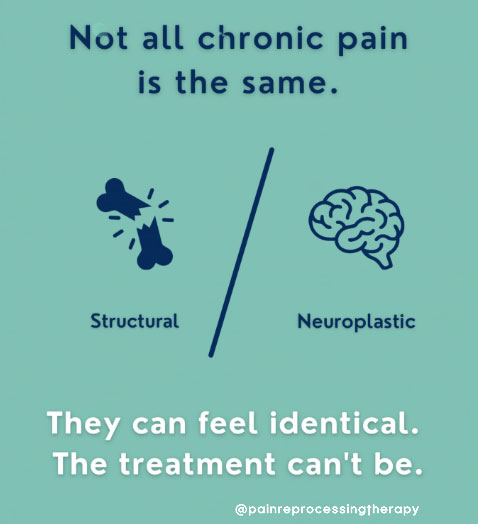
The same ache. The same intensity. The same spot. But not always the same cause.
Structural pain comes from tissue damage: an injury, inflammation, something physically wrong. Neuroplastic pain comes from a brain that learned to sound the alarm even after the danger has passed. And often, it’s not one or the other. Many people have mixed pain, a real structural component that gets amplified by a nervous system stuck in overprotection mode.
That’s why the same sensation can call for different approaches, sometimes medical treatment, sometimes nervous system work, often both at once. @painreprocessingtherapy
What is Neuroplastic Pain?
Let the truth be told…
Recent studies have shown that chronic back pain, neck pain, fibromyalgia symptoms, repetitive strain injury, headaches, and other forms of chronic pain are often not the result of structural causes, but of psychophysiologic processes that can be reversed. This is known as neuroplastic pain.
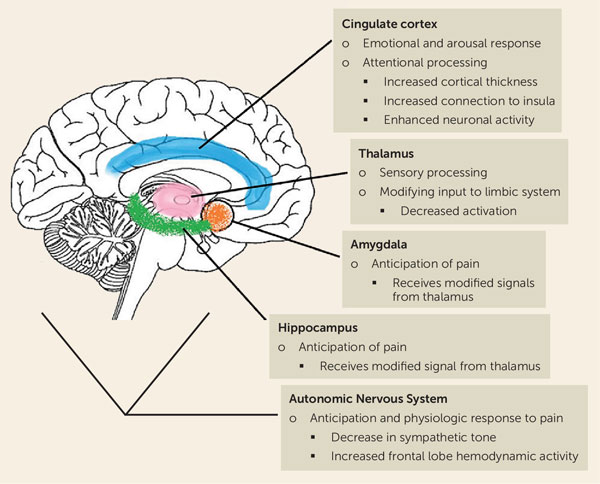
Neuroplastic pain often begins with acute injury and nociception. Emotional responses, such as fear, anxiety, and vigilance, are adaptive in the acute setting but may persist after tissue healing and become maladaptive. Through associative learning, fear and anxiety can become subconsciously linked with pain, creating a self-reinforcing loop, “neurons that fire together wire together”
What Causes Chronic Pain?
Chronic pain isn’t always caused by ongoing injury or damage. In this video, Dr. Howard Schubiner explains what modern neuroscience reveals about where persistent pain comes from—and why it can continue long after tissues have healed.
Many people living with chronic pain have been told that their symptoms are “all in their head” or that nothing can be done because medical tests don’t show a clear cause. But the latest research on chronic pain, neuroplastic pain, brain-based pain, and nervous system regulation suggests a different explanation.
Dr. Howard Schubiner explores how the brain generates pain, why pain does not always equal damage, and how stress, emotions, fear, learned neural pathways, and the nervous system can influence chronic symptoms. You’ll learn why pain can feel completely real even when there is no ongoing injury, and why understanding the science behind pain can be a powerful first step toward recovery.
Whether you’re experiencing back pain, neck pain, fibromyalgia, chronic symptoms, or unexplained pain that hasn’t responded to traditional treatments, this conversation offers a science-based perspective on how pain works and what recovery may look like.
Neuroplastic Symptoms: How to Know If Your Symptoms Are Neuroplastic
Neuroplastic symptoms can be confusing—especially when tests, scans, or diagnoses don’t fully explain what you’re experiencing. In this video, Dr. Howard Schubiner explains how to tell whether chronic pain and symptoms may be neuroplastic rather than caused by ongoing structural damage.
Many people living with chronic pain, fibromyalgia, IBS, migraines, dizziness, pelvic pain, long COVID symptoms, and other persistent conditions wonder the same thing: How do I know if my symptoms are neuroplastic? Dr. Schubiner shares the exact process he uses with patients to answer that question.
First, you’ll learn how to rule out serious structural causes of symptoms. Then you’ll discover the FIT Criteria—a practical framework for identifying signs that pain and symptoms may be driven by learned neural pathways, nervous system sensitization, and the brain’s danger response rather than ongoing tissue damage.
Along the way, Dr. Schubiner explains:
- Why MRI findings often don’t explain chronic pain
- How symptoms can persist long after an injury has healed
- Why symptom patterns often provide important diagnostic clues
- How stress, attention, emotions, and life circumstances can influence symptoms
- Real-world examples of neuroplastic symptoms and recovery
Video References: @curablehealth on YouTube